
After the Audit
What my notes system revealed once the cleaning stopped

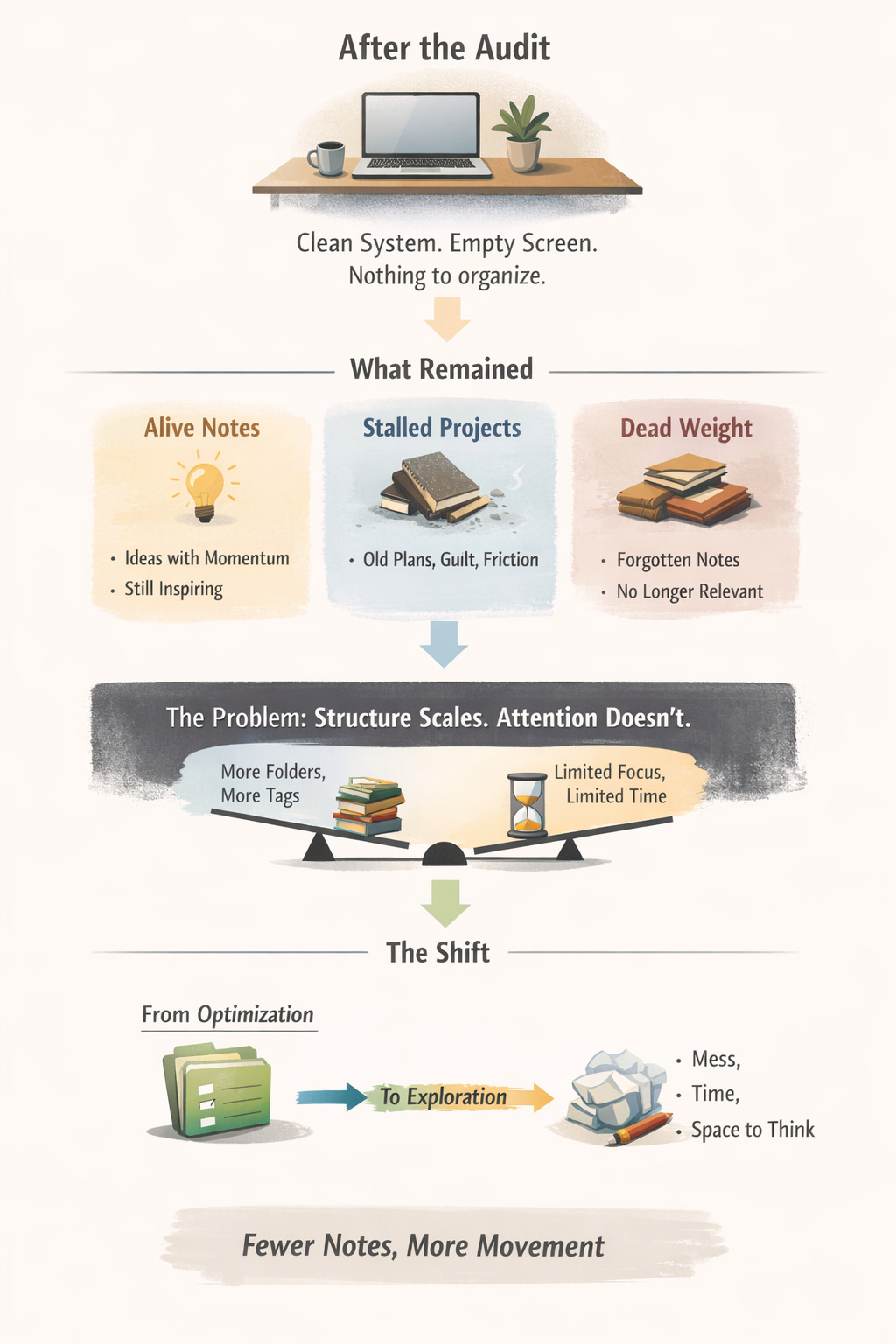
I closed the last folder and sat back in my chair.
The notes system was quiet. No loose files. No half-finished clean-ups. Everything was where I had decided it should go.
I had been working toward this moment for weeks. The PKM audit was done.
I opened a new note and stared at the cursor.
There was nothing left to organize.
That was when the discomfort surfaced.
There is a particular kind of silence that appears after you finish cleaning. It feels earned. You have made decisions. You have reduced noise. You have prepared the space. But preparation has an end point. Once the system is tidy, the only thing left is the work itself.
I sat there longer than I expected to.
No tags to add, no folders to adjust, no mess left to fix.
What’s left was just thinking.
And that was the moment I realized the audit hadn’t really been about my notes. It had been about what I was avoiding.
What I thought I was doing
I told myself I was maintaining the system.
I framed the audit as hygiene. Good stewardship. A responsible end-of-year reset. I was clearing out what no longer served me so I could start fresh.
But if I’m honest, the organizing felt good because it gave me something to do that wasn’t thinking.
Cleaning is safe work. It has edges. You can tell when it’s done. You can feel productive without having to confront uncertainty. Rearranging notes feels like progress, even when it’s just movement.
Thinking, on the other hand, is slippery. You can sit with a problem for an hour and feel like you’ve gone backwards. There’s no clear signal that says “this counts.”
Looking back, I can see how easily maintenance had become a substitute for engagement. As long as there was something left to optimize, I didn’t have to sit with the harder question of what I was actually trying to say.
What survived the audit
When I stopped cleaning and started looking, patterns emerged quickly.
Some notes felt alive.
These were the ones I kept returning to without forcing myself. They didn’t need reminders or structure to stay relevant. Ideas inside them folded naturally into essays, conversations, or projects. They had momentum. I didn’t manage them. I just picked them up again.
Other notes had stalled.
These were harder to face. Ambitious outlines from months ago. Research threads that once felt urgent and now felt distant. My first reaction was guilt. I assumed I had failed to follow through.
But with a little distance, I could see something else. The season had simply changed. The problem that sparked those notes no longer mattered in the same way. Keeping them visible wasn’t discipline. It was friction.
And then there was the dead weight.
Notes that made perfect sense when I captured them but felt alien now. Ideas that represented an older version of me, or an interest I no longer had. Keeping them felt neutral on the surface, but it wasn’t. Every search had more noise. Every return to the system carried a subtle sense of obligation.
Deleting those notes felt disproportionally hard. Not because they were valuable, but because they proved I had once cared.
Letting them go felt like admitting that not every intention needs to be honored forever.
The uncomfortable pattern
As the system got lighter, something else became obvious.
Capture is easy. I’m very good at saving things.
Retrieval is also easy. If I need a quote or a reference, I can find it in seconds.
But recycling ideas, bringing them back into active circulation, is much harder.
My system was optimized for intake. It was excellent at pulling information inward. What it didn’t support well was the slow, repetitive work of turning an idea over until it changed shape.
That’s when the core tension surfaced.
Structure scales quickly. Attention doesn’t.
I can add folders, tags, and links indefinitely. But I can’t add more hours of focus. When everything in a system moves inward, it quietly builds pressure. The volume grows. The responsibility grows. And eventually, the system starts to feel heavier instead of helpful.
The audit didn’t reveal a messy system. It revealed a misaligned one.
The deeper question I hadn’t asked
I realized I had spent years asking the wrong questions.
I had asked how to organize better.
How to capture faster.
How to retrieve more efficiently.
What I hadn’t asked was simpler, and more uncomfortable.
What kind of thinking is this environment actually designed to support?
Tools are not neutral. They have opinions. A task manager wants you to close loops. A calendar wants you to move forward. My notes system, I realized, had been built for a librarian.
The librarian in me loves order. He enjoys clean structures, precise labels, and the quiet satisfaction of everything being in its place. He gets a small hit of pleasure every time a note is properly filed.
But the writer in me was suffocating.
The writer doesn’t need everything named right away. He needs to put two half-formed thoughts next to each other and stare at them for days. He needs to be wrong in private. He needs room to circle the same idea without being asked to justify why it exists yet.
This explained something I’d been ignoring for a long time.
My best thinking often happened away from the screen, on scrap paper. Paper has no opinion. It doesn’t ask for tags. It doesn’t demand clarity up front. It allows ideas to be slow, circular, and unfinished.
My digital space had been too polite. Too efficient. Too eager to resolve things.
What thinking actually needs
Thinking doesn’t need more speed.
It needs time, friction, and permission.
It needs places where an idea can sit unlabelled. Where it can be returned to across days, not rushed into a conclusion in one sitting. It needs repetition. Not because repetition is efficient, but because clarity often arrives on the third or fourth pass.
Mess isn’t a flaw in this process. It’s evidence that something is still alive.
A system that only rewards completion quietly discourages exploration. If every thought has to be processed immediately, fewer thoughts are allowed to exist in their fragile state.
I’m learning to value notes that change shape over notes that look finished. Notes that argue back. Notes that feel slightly uncomfortable to reread because they haven’t settled yet.
Those are the ones that tend to lead somewhere.
Small changes, real effects
I didn’t redesign the entire system after this realization. I changed how I behaved inside it.
I left difficult notes open instead of closing them when a session ended. Seeing them again the next day invited another sentence, then another.
I stopped highlighting aggressively and started rewriting ideas from memory. Getting them wrong forced me to engage instead of collect.
I captured moments of friction instead of definitions. What felt off. What surprised me. What resisted easy explanation.
None of this made the system look better. But it made it easier to return to.
The pressure lifted. The notes stopped feeling like a demanding archive and started feeling like a workbench again.
Where I landed
The audit didn’t give me a perfect notes system.
It gave me fewer notes, less noise, and more movement.
I’m no longer trying to build a library for a future version of myself. I’m trying to create a space that supports the thinking I want to do now.
The goal isn’t to have everything saved. It’s to have a few ideas that are actually moving.
That feels like enough for the moment.
Until next time,
Gav