
The Empty Library
Why I stopped collecting facts and started saving confusion.

Yesterday morning, I caught myself doing something that used to feel smart, but suddenly felt like a waste of time.
I was reading an article about a new piece of technology. I highlighted a paragraph. I opened my notes app. I made a new note. I added a tag. I filed it into a folder called “Tech.”
I spent three minutes making sure the note looked perfect.
Then I stopped.
A quiet question popped into my head: Why am I saving this?
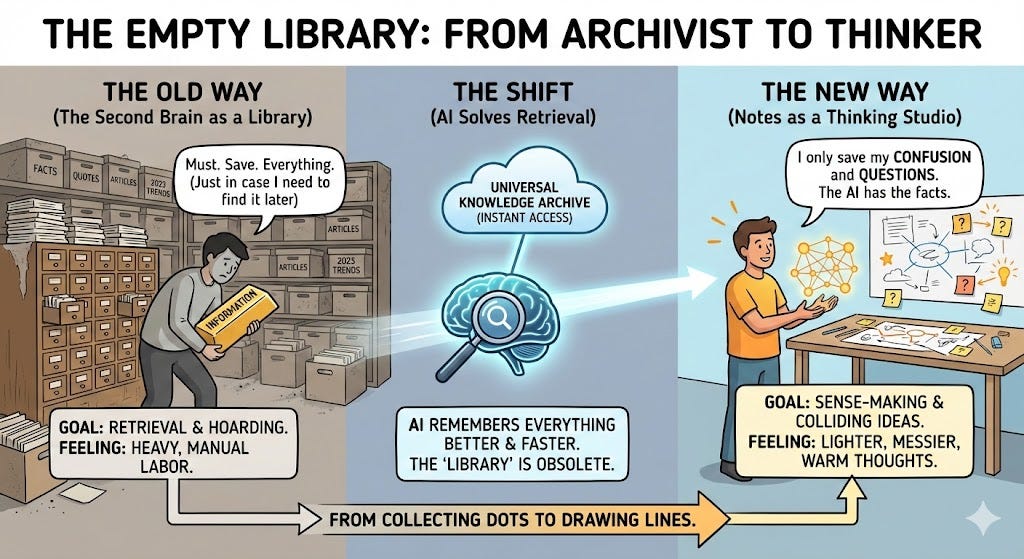
Three years ago, the answer was easy. I was saving it so I wouldn’t lose it. I was building a “Second Brain” to keep track of facts, because my real brain forgets things.
But sitting there, looking at my perfectly filed note, I realized something. If I need to know about that technology in six months, I won’t look in this folder. I won’t search for my tag.
I will just ask an AI.
And the AI will give me a better, faster answer than the note I just spent three minutes writing.
This is the friction I have been feeling lately.
For a long time, we were told that being productive meant acting like a librarian. We collected information. We organized it. We treated facts like gold bars that we had to hoard.
But as we move toward 2026, finding information is no longer hard. It is free. And if information is free, being a librarian isn’t a very useful job anymore.
I think the way we use our notes is about to change.
The Problem with Saving Everything
The main reason we built Second Brains was to find things later.
We saved quotes and articles because we were scared we would never see them again. We didn’t trust our memory, and we didn’t trust the internet to keep things organized.
That fear is gone now.
We have AI tools that have read almost everything. The problem of “finding things” is solved. You don’t need to build your own personal Google anymore. The real AI is smarter and faster than your folders will ever be.
This creates a weird feeling for those of us who love our notebooks.
If the computer remembers the facts better than we do, what is the point of writing anything down?
I spent a few weeks thinking about this. My notes app felt dead. It felt like a storage unit full of boxes I never opened.
But slowly, I started to see a new way to work.
If I stop treating my notes as a Library (a place to store facts), I can start treating them as a Studio (a place to do work).
Less Collecting, More Thinking
I have changed how I write. It is a small change, but it feels big.
I have stopped saving other people’s work.
I don’t save generic “how-to” guides anymore.
I don’t save definitions of words.
I don’t save lists of trends. If the information is generic, the AI can find it for me later.
Instead, I only write down things the AI cannot copy: my own confusion.
My notes are no longer about what is true in the world. They are about what is happening in my head.
Old Note: A definition of a science term I copied from a website.
New Note: A paragraph writing about why I don’t understand that term, or how it confuses me.
Old Note: A list of “10 Predictions for 2025.”
New Note: A short diary entry about why one of those predictions scares me.
The Second Brain isn’t for facts anymore. It is for making sense of things.
The machine can find data, but it cannot find my perspective. It cannot feel the specific way I am stuck on a problem today.
A Messier System
This change has messed up my system, in a good way.
It is less organized now. I don’t worry as much about folders or strict tags. Those things felt like armor for a battle that is already over.
I spend less time organizing and more time writing. I worry less about “will I find this in five years?” and more about “does writing this right now help me think clearly?”
We used to be Collectors. We tried to have the most dots.
Now, the machine has all the dots.
Our job is to draw the lines between them.
A Lighter Load
I am not saying we should delete our notes. We still need a place to think.
But we can stop carrying so much weight. We can stop trying to be archivists. We can stop worrying about “information overload,” because we don’t have to carry the information anymore.
We just need to carry the questions.
My notebook is smaller than it was last year. I save less. I delete more.
But the things that stay in there feel different. They aren’t cold facts waiting to be found. They are warm thoughts, still moving.
That feels like enough for now.
How does AI change the way you take notes? I’d love to know.
That’s it from me for this week.
Until next time,
Gav.